
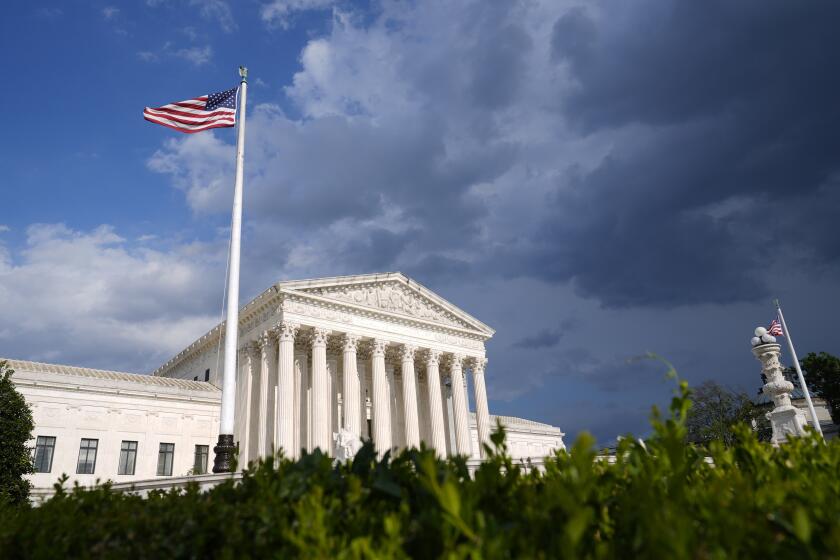
A U.S. Supreme Court police officer walks in front of the Supreme Court building, which is undergoing renovations, in Washington on Monday.
(J. Scott Applewhite/AP)

By
David G. SavageStaff Writer
FollowDec. 9, 2025
2:50 PM PT
6 min
Click here to listen to this article
Share via
Close extra sharing options
Email Facebook X LinkedIn Threads Reddit WhatsAppCopy Link URL
Copied!
0:00
0:00
1x
This is read by an automated voice. Please report any issues or inconsistencies here.
Supreme Court conservatives signaled Tuesday they will likely strike down limits on money political parties can raise to support candidates.
The ruling would enable parties to accept unlimited contributions from wealthy donors in what critics say would increase corruption risks.
The decision continues a decades-long erosion of campaign finance protections, allowing special interests greater influence in federal campaigns.
WASHINGTON — The Supreme Court’s conservatives signaled Tuesday they are likely to rule for Republicans and President Trump by throwing out a Watergate-era limit on campaign funding by political parties.
The court has repeatedly said campaign money is protected as free speech, and the new ruling could allow parties to support their candidate’s campaigns with help from wealthy donors.
For the second day in a row, Trump administration lawyers urged the justices to strike down a law passed by Congress.And they appeared to have the support of most of the conservatives.
The only doubt arose over the question of whether the case was flawed because no current candidate was challenging the limits.
Advertisement
“The parties are very much weakened,” said Justice Brett M. Kavanaugh. “This court’s decisions over the years have together reduced the power of political parties, as compared to outside groups, with negative effects on our constitutional democracy.”
He was referring to rulings that upheld unlimited campaign spending by wealthy donors and so-called SuperPACs.
 Supreme Court sounds ready to give Trump power to oust officials of independent agencies
Supreme Court appears set to expand presidential power and upset nine decades of law on independent agencies.
Dec. 8, 2025
In the Citizens United case of 2010, Chief Justice John G. Roberts Jr. and four other conservatives struck down the long-standing limits on campaign spending, including by corporations and unions. They did so on the theory that such spending was “independent” of candidates and was protected as free speech under the 1st Amendment.
Advertisement
They said the limits on contributions to candidates were not affected. Those limits could be justified because the danger of corruption where money bought political favors. This triggered a new era of ever-larger political spending but most of it was separate from the candidates and the parties.
Last year, Elon Musk spent more than $250 million to support Donald Trump’s campaign for reelection. He did so with money spent through political action committees, not directly to Trump or his campaign.
Meanwhile the campaign funding laws limit contributions to candidates to $3,500.
Lawyers for the National Republican Senatorial Committee pointed out this trend and told the Supreme Court its decisions had “eroded” the basis for some of the remaining the 1970s limits on campaign funding.
Advertisement
At issue Tuesday were the limits on “coordinated party spending.” In the wake of the Watergate scandal, Congress added limits on campaign money that could be given to parties and used to fund their candidates. The current donation limit is $44,000, the lawyers said.
Tariffs and birthright citizenship will test whether Trump’s power has limitsThe Supreme Court’s conservatives have yet to put limits on Trump’s broad claims of executive power.
Oct. 5, 2025
Washington attorney Noel Francisco, Trump’s solicitor general during his first term, urged the court strike down these limits on grounds they are outdated and violate the freedom of speech.
“The theory is that they’re needed to prevent an individual donor from laundering a $44,000 donation through the party to a particular candidate in exchange for official action,” he said.
Advertisement
If a big-money donor hopes for win a favor from a congressional candidate, the “would-be briber would be better off just giving a massive donation to the candidate’s favorite super PAC,” he said.
The suit heard Tuesday was launched by then Sen. JD Vance of Ohio and other Republican candidates, and it has continued in his role as vice president and possibly a presidential candidate in 2028.
Usually, the Justice Department defends federal laws, but in this instance, the Trump administration switched sides and joined the Republicans calling for the party spending limits to be struck down.
Precedents might have stood in the way.
In 2001, the Supreme Court had narrowly upheld these limits on the grounds that the party’s direct support was like a contribution, not independent spending. But the deputy solicitor general, Sarah Harris, told the justices Tuesday that the court’s recent decisions have “demolished” that precedent.
“Parties can’t corrupt candidates, and no evidence suggests donors launder bribes by co-opting parties’ coordinated spending with candidates,” she said.
 Here are 5 major Supreme Court cases to be argued this fall
Transgender rights, voting rights and Trump tariffs face challenge in the Supreme Court this fall.
Oct. 5, 2025
Marc Elias, a Democratic attorney, joined the case in the support of the court limits. He said the outcome would have little to do with speech or campaign messages.
Advertisement
“I think we’re underselling the actual corruption” that could arise, he said. If an individual were to give $1 million to political party while that person has business matter before the House or Senate, he said, it’s plausible that could influence “a deciding or swing vote.”
The only apparent difficulty for the conservative justices arose over questions of procedure.
Washington attorney Roman Martinez was asked to defend the law, and he argued that neither Vance nor any other Republicans had legal standing to challenge the limits. Vance was not a current candidate, and he said the case should be dismissed for that reason.
Advertisement
Some legal observers noted that the limits on parties arose in response to evidence that huge campaign contributions to President Nixon’s reelection came from industry donors seeking government favors.
 Supreme Court rules for Texas Republicans, allowing new election map to go into effect
Thanks to the Supreme Court’s ruling, Republicans are expected to win five extra seats in the House of Representatives.
Dec. 4, 2025
“Coordinated spending limits are one of the few remaining checks to curb the influence of wealthy special interests in our elections,” said Omar Noureldin, vice president for litigation at Common Cause. “If the Supreme Court dismantles them, party leaders and wealthy donors will be free to pour nearly unlimited money directly into federal campaigns, exactly the kind of corruption these rules were created to stop.”
Daniel I. Weiner, an elections law expert at the Brennan Center, said the justices were well aware of how striking down these limits could set the stage for further challenges.
Advertisement
“I was struck by how both sides had to acknowledge that this case has to be weighed not in isolation but as part of a decades-long push to strike down campaign finance rules,” he said. “Those other decisions have had many consequences the court itself failed to anticipate.”
More to Read
 Supreme Court’s conservatives face a test of their own in judging Trump’s tariffs
Nov. 4, 2025

Voices
Contributor: Will the Supreme Court uphold Trump’s power grabs?Oct. 1, 2025
 Justices skeptical of Trump plan to limit birthright citizenship but also injunctions that block it
May 15, 2025